Introduction
It is a very basic question, but we begin our journey by answering the simple ones and work our way to complex, in-depth questions as our foundation in our knowledge grows.
We have to learn to walk before we can run
- E.L James
So what is sound?
Sound as we know it, is the vibration of air particles. That translates to vibrations to our eardrums, which then transfers the energy to tiny nerve endings inside our ear and that is perceived as sound!
That is simple enough, no?
Lets dive deeper.
Sound as a Medium
Now that we know that sound is made out of vibrations, how do the vibrations move along the air?
When something makes a sound, it vibrates - let's just take a speaker in example.
The diaphragm of the speaker moves forward and backwards, at many times per second. This movement vibrates the air in front and behind of it, by pushing and pulling the air many times a second.
The number of times a second that a vibration occurs (e.g. 50 times per second) is the frequency of that particular sound. This is known as Hertz, aka Hz. 50 vibrations per second equals to 50Hz.
This causes the air to compress and de-compress multiple times per second!! That is quite a concept if you think about it.
When the air is compressed by the speaker pushing forward, we call that part of the "wave" a compression.
When the air is de-compressed by the speaker pulling backward, we call that part of the "wave" a rarefaction.
So instead of a wave that looks like this...
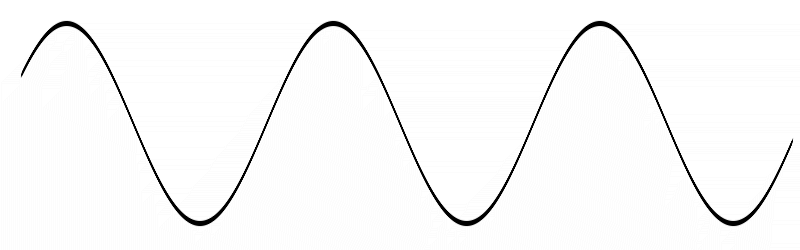
The wave of sound looks a bit more like this!
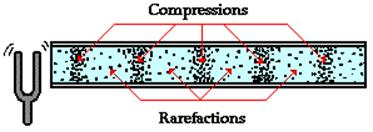
You can observe that instead of waves going up and down, the vibrations can be visualized as pressure waves that has more air particles, or less.
IF the sound was loud enough and low frequency enough, you can actually feel the sound "hit" you - and you probably have already! If you have been at a concert or church service where there is a large enough subwoofer, you often feel the bass just as much as you hear it.
Subwoofers were designed for low frequencies, these go down to 20Hz, sometimes even lower!
Frequencies these low are often felt more than you hear them, especially at louder volumes.
You don't hear the sound because it goes up and down, you hear it because the air is compressing and decompressing and that change in pressure is detected by your ears.
That is the basics, and then some, of what SOUND is.
I hope you learnt something and found that fascinating! Why did we learn this? Because much later down the line, knowing HOW sound works is important in making things sound better! We will cover that and revisit this when the time is right.